
|
Will NATO survive? The Bible says "No!"
Crisis in the Middle East Causes Cracks in NATO
|
|
Sunday, April 12, 2026
|
www.bibleinthenews.com Audio & Print versions
|
The current crisis in the Middle East is beginning to disintegrate NATO. The nations of the 70-year-old alliance are pulling in different directions, causing it to tear apart. The Bible is clear about what alliances will exist in the latter days. In this Bible in the News, we examine the evidence the Bible gives for the direction things will inevitably go.
The past six weeks have seen unprecedented action in the Middle East. Israel and the United States have been waging war against Iran. Israel’s operation is entitled “Roaring Lion”, while the US version is entitled “Operation Epic Fury.” These actions have dramatically hampered Iran’s ability to influence the Middle East through its proxies. The shaky cease-fire, which has been called this week, is allowing Israel to focus its full attention on Hezbollah in Lebanon, further degrading their ability to strike Israel.
Temporary Versus True Peace in the Middle East
All of this is leading toward an eventual outcome of “peace” in the Middle East. Peace in the Middle East is an inevitable outcome because the Bible demands it in the time when Russia invades Israel:
“And thou shalt say, I will go up to the land of unwalled villages; I will go to them that are at rest, that dwell safely, all of them dwelling without walls, and having neither bars nor gates, To take a spoil, and to take a prey; to turn thine hand upon the desolate places that are now inhabited, and upon the people that are gathered out of the nations, which have gotten cattle and goods, that dwell in the midst of the land.” (Ezekiel 38:11–12)
Current developments in the Middle East are leading toward that time, setting the stage for peace and prosperity that the region has yet to see. This will not bring true and lasting peace, for that will require the return of the Messiah, and the conversion of the entire nation:
“Then judgment shall dwell in the wilderness, And righteousness remain in the fruitful field. And the work of righteousness shall be peace; And the effect of righteousness quietness and assurance for ever.” (Isaiah 32:16–17)
It is the reign of Messiah and the building of the temple that will bring the peace Micah describes:
“But in the last days it shall come to pass, That the mountain of the house of the Lord shall be established in the top of the mountains, And it shall be exalted above the hills; And people shall flow unto it. And many nations shall come, and say, Come, and let us go up to the mountain of the Lord, And to the house of the God of Jacob; And he will teach us of his ways, And we will walk in his paths: For the law shall go forth of Zion, And the word of the Lord from Jerusalem. And he shall judge among many people, And rebuke strong nations afar off; And they shall beat their swords into plowshares, And their spears into pruninghooks: Nation shall not lift up a sword against nation, Neither shall they learn war any more. But they shall sit every man under his vine and under his fig tree; And none shall make them afraid: For the mouth of the Lord of hosts hath spoken it.” (Micah 4:1–4)
The events that are currently taking place are transforming conditions in the Middle East to bring about the temporary peace required by the Bible.
NATO – What is it?
These are not the only events that are setting the stage for the invasion in the latter days. One of the outcomes of this current conflict is the future of NATO.
NATO is short for the North Atlantic Treaty Organization. It is a military alliance of countries that was designed to work together for defense and security. It was created at the end of World War II to counter threats from the Soviet Union, as the world devolved into two ideological blocs. NATO was the Western Bloc, advocating capitalism, with the United States as the leading power. The Eastern Bloc was centred on Communism, with the Soviet Union as its leading power. It used to be organized under the Communist Bloc. The following map shows the division of nations between NATO and the WARSAW PACT during the time of the Cold War when the “Iron Curtain” descended across Europe.
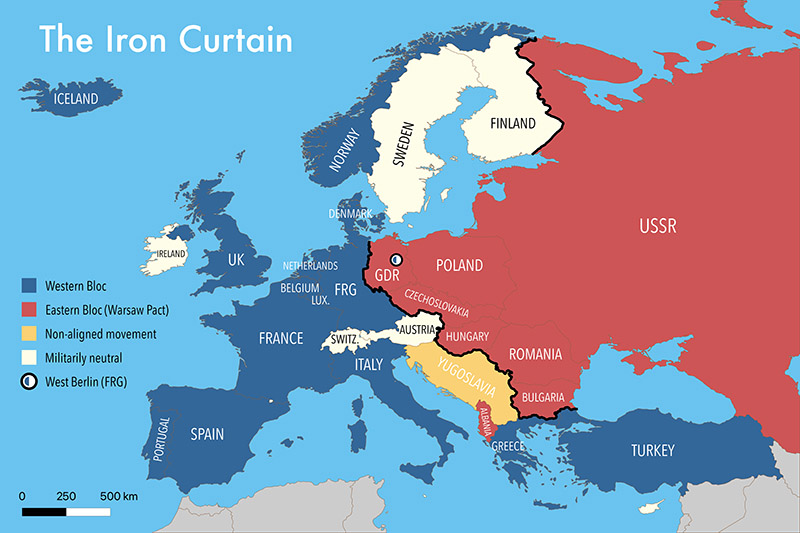
In 1989, the Communist Bloc collapsed, and in 1991, the Soviet Union disintegrated. This gave NATO a free hand. Many former Communist Bloc countries joined NATO following the collapse of the Soviet Union.
Russia has been looking to reassert its influence over the former Communist Bloc nations since this time. The war in Ukraine is Russia seeking to regain its control of what it views as strategic areas it once owned. When Germany reunited in 1991, Eastern Germany automatically became part of NATO.
In 1999, Poland, the Czech Republic, and Hungary all joined NATO. In 2004, Estonia, Latvia, Lithuania, Romania, Bulgaria, Slovakia (a break off from the former Czech Republic), and Slovenia (part of the former Yugoslavia) joined NATO. In 2009 Albania and Croatia (part of the former Yugoslavia) joined NATO. In 2017, Montenegro (also a part of the former Yugoslavia), joined NATO. In 2020, Northern Macedonia (also a part of the former Yugoslavia) joined NATO.
The war in Ukraine began, according to Russia, because NATO was trying to continue its expansion toward the East into Ukraine. As a reaction to the war in Ukraine Finland joined NATO in 2023, and Sweden joined in 2024.
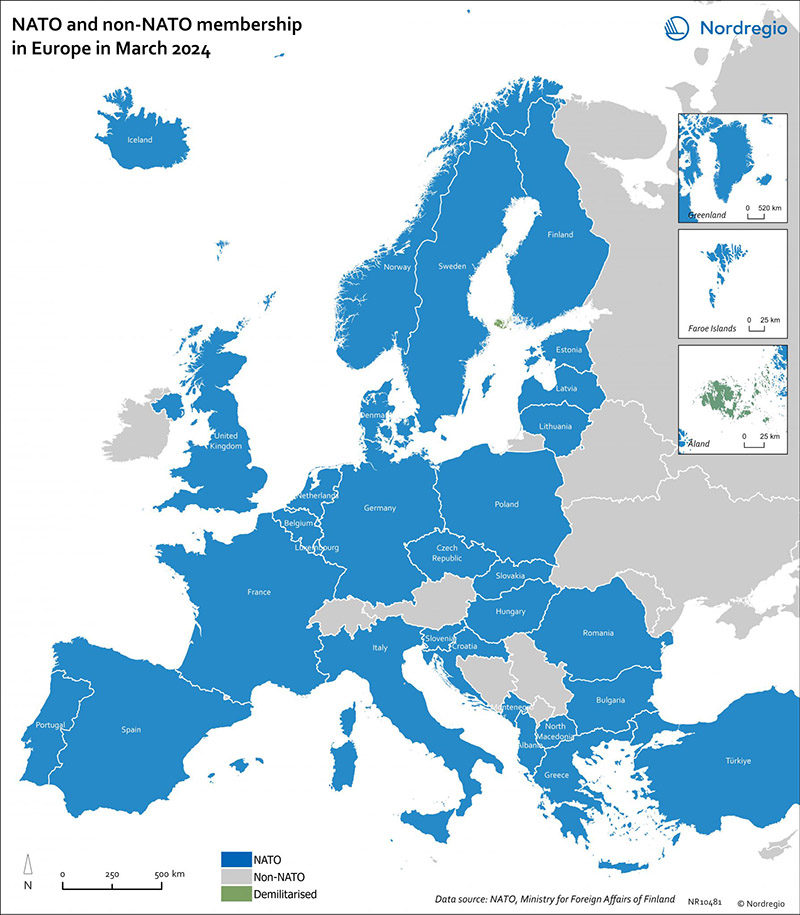
The following map above shows the extent of NATO in 2024. Added to this would be the United States and Canada. (Designed by Maria Bobrinskaya).
NATO coordinates the military forces of all its member states. If one of them is attacked, Article 5 is invoked. Article 5 commits each member state to consider an armed attack against one member state to be an armed attack against them all. Each member state is called upon to “take such action as [the member state] deems necessary, including the use of armed force, to restore and maintain the security of the North Atlantic area.” The whole idea behind this is deterrence: the Soviet Union would be engaging the entire Western Bloc if it engaged one nation in military action.
The only time Article 5 was invoked was following the September 11th, 2001, attack on the United States.
NATO – out of step with the Bible
The fact is, NATO, while it has served a purpose to keep the Soviet Union in check after the Cold War began, is out of step with the Bible. The Bible speaks of entirely different blocs of countries in alliance with each other.
Daniel’s Description of Latter-Day Power Blocs
The prophet Daniel speaks in broad terms of a “King of the North” and a “King of the South”:
“And at the time of the end shall the king of the south push at him: and the king of the north shall come against him like a whirlwind, with chariots, and with horsemen, and with many ships; and he shall enter into the countries, and shall overflow and pass over.” (Daniel 11:40)
Allied with this “King of the North” are the Libyans and Ethiopians, while Egypt is a target of his aggression:
“He shall stretch forth his hand also upon the countries: and the land of Egypt shall not escape. But he shall have power over the treasures of gold and of silver, and over all the precious things of Egypt: and the Libyans and the Ethiopians shall be at his steps.” (Daniel 11:42–43)
Ancient Libya covered much of North Africa, from Egypt Westward. Ethiopia was known as “Cush” in Hebrew and covered what we would now term as modern Sudan, Eritrea, and northern Ethiopia.
Daniel also informs us that the nations of Edom, Moab and Ammon (modern day Jordan) would not be with the northern alliance but would be saved out of their hand, while other countries would be overthrown:
“He shall enter also into the glorious land, and many countries shall be overthrown: but these shall escape out of his hand, even Edom, and Moab, and the chief of the children of Ammon.” (Daniel 11:41)
The “him” of Daniel 11 is Turkey, or the Ottoman Turks before the empire was dissolved. This is the focus of the King of the South first, and then the King of the North. He enters Turkey, and into “the countries” before he “overflows and passes over” into the “glorious holy land.” This would indicate Syria and Lebanon are on the list of nations to be subdued, but not under his sphere of influence initially. The “glorious holy land” is the land of Israel, which the alliance appears to overflow and pass over. It is not until he hears “tidings” that he returns to Israel to temporarily establish himself in the holy mount:
“But tidings out of the east and out of the north shall trouble him: therefore he shall go forth with great fury to destroy, and utterly to make away many. And he shall plant the tabernacles of his palace between the seas in the glorious holy mountain; yet he shall come to his end, and none shall help him.” (Daniel 11:44–45)
The return of the King of the North into the land of Israel is captured in Ezekiel 38.
Ezekiel’s Description of Europe at the Time of the End
Ezekiel 38 provides a clear breakdown of which European nations are on which side during the invasion:
“Son of man, set thy face unto Gog, of the land of Magog, prince of Rosh, Meshech, and Tubal, and prophesy concerning him,” (Ezekiel 38:2 YLT)
Gog is identified as the leader, described in Young’s Literal Translation as the prince of Rosh, Meshech and Tubal. He is the ruler over Rosh, identified by ancient historians and lexographers as the nation of Russia. Gesenius in his Hebrew-Chaldee Lexicon of the Old Testament tells us of Rosh:
“… a proper name of a northern nation mentioned with Tubal and Meshech; undoubtedly the Russians, who are mentioned by Byzantine writers of the tenth century under the name of Rus, dwelling to north of the Taurus (Don), and described by Ibn Fadlan, an Arabic writer of the same age, as dwelling on the river Rha (Volga).”
The 9th-century Muslim historian Muhammad ibn Musa al-Khwarizmi, better known by his Arabic name Al-jabr, (as he was both a geographer and also the inventor of the mathematical system of algebra) had the following to say:
“The Rus… a tribe of the Slavs bringing beaver skins and black fox fur and swords from the furthest parts of their land down to the Black Sea. The Greek Emperor charges tithe on their goods, and if they go the way of the Don passing Khamlij, the capital of the Khazars, their Prince also takes his tithe. They reach the Caspian and take ship again. Sometimes they bring their wares by camel from Jurjan to Baghdad where Slovonic eunuchs interpret for them. They say they are Christian and pay taxes as such.”
To these are added the testimonies of their own historians such as the Russian monk Nestor in his Chronical of the Kievan Rus, living between 1056-1136 AD, who writes:
“After the deluge, three sons of Noah, Shem, Ham and Japhet, divided up the earth... Japhet lands included the North side of the Black Sea with rivers Danube, Dnister, Dnipro and Volga, which flows toward Shem's part of the earth. These lands contained numerous tribes such as the Rus... In the year 6360 (852), at the accession of the Emperor Michael, the land of Rus’ was first named. We have determined this date from the fact that in the reign of this Emperor Rus’ attacked Tsargrad (Constantinople), as is written in the Greek Chronicle.... the Slavs and the Rus’ are one people, for it is because of the Varangians that the latter became known as Rus’, though originally they were Slavs.”
The Historian Bochart, in his Geography of Canaan, writing in 1651 stated:
It is credible that from Rosh and Meshech of whom Ezekiel speaks descended the Russians and Muscovites, nations of the greatest celebrity in European Scythia…. Rosh is the most ancient form under which history makes mention of the name of Russia.
The Russian president himself stated in 2021:
Russians, Ukrainians, and Belarusians are all descendants of Ancient Rus, which was the largest state in Europe… bound together by one language which we now refer to as Old Russian… and, after the baptism of Rus, the Orthodox faith.
Gog is the leader of the Northern Confederacy, the prince of Russia, but also Meshech and Tubal. Meshech is likewise identified by Historians as the Muscovites, originally the Moschi, who migrated north and who later inhabited the area around Moscow, giving their name to the region. Tubal is the region of Tobolks. Newton Brown’s Encyclopedia of Religious Knowledge written in 1851 sums these two up:
“TUBAL: fifth son of Japhet, who is commonly united with Meshech; whence it is thought that they people countries bordering each other. Bochart is very copious to prove, that by Meshech and Tubal are intended the Muscovites and the Tibarenians…. Magog, Meshech and Tubal are noticed together by Ezekiel, as settled in the North, and as ancestors of the numerous Slavonic and Tartar races. The first may be traced in the Mongoguin; the second, Meshech, or Mosoc, (as it is in the Greek), in the Moschi, Moscow, and Muscovites: the third in the Tobolski of Siberia.”
The prince of Rosh is identified as being from the land of Magog. Josephus, the Jewish historian identifies Magog with the Scythians. Herodotus, the Greek historian, identifies Scythia as lying between the Rivers Don and the Danube. It is the River Don that gives its name to the Donbas (or Don bason region) that is the object of the war being fought by Russia against the Ukraine. However, the Bible does not limit it to this region, adding:
“Gomer, and all his bands; the house of Togarmah of the north quarters, and all his bands: and many people with thee.” (Ezekiel 38:6)
Genesis 10 tells us Gomer was a son of Japheth:
“The sons of Japheth; Gomer, and Magog, and Madai, and Javan, and Tubal, and Meshech, and Tiras. And the sons of Gomer; Ashkenaz, and Riphath, and Togarmah. And the sons of Javan; Elishah, and Tarshish, Kittim, and Dodanim. By these were the isles of the Gentiles divided in their lands; every one after his tongue, after their families, in their nations.” (Genesis 10:2–5)
The scriptures inform us, Gomer is related to Magog, Tubal and Meshech. His son is Ashkenaz, the name given by Jews to the Black Sea, or Ashkenazi Sea as they call it. European Jews are referred to as Ashkenazi Jews. Edward Wells, in his history, written in 1708-1711 relates:
The Jewish historian Josephus, tells us expressly, the Galatians (who lived in this tract, and to whom St. Paul wrote an Epistle) were called Gomerites; and Herodotus tells us, that a people called Cimmerii dwelt in these parts… the colonies, which coming from the nation of Gomer, in process of time spread themselves further and further, and settled themselves in several parts of Europe… This colony of the Cimmerii, increasing in process of time, and so spreading themselves till by new colonies further westward, came along the Danube, and settled themselves in the country which from them has been called Germany… Out of Germany, the descendants of Gomer spread themselves into Gaul or France.”
This is the group that is allied with Russia in the time of the end. The nations of Europe, extending to France and Germany, will form this great confederacy and make an alliance with Russia. United with them are the same nations identified by Daniel as being united with the King of the North, which we have already identified:
“Persia, Ethiopia, and Libya with them; all of them with shield and helmet:” (Ezekiel 38:5)
The Headlines Today
What we are seeing today in the headlines is the cracking of the NATO alliance. This is required by Scripture to form the Gogian alliance described by Ezekiel, or “King of the North” as Daniel describes him.
The contest in Iran has put NATO’s existence on notice. President Trump specifically asked for NATO’s assistance in opening the Straight of Hormuz. The Times of Israel reported on March 16:
US President Donald Trump has warned that NATO faces a “very bad” future if US allies fail to assist in opening up the Strait of Hormuz, in an interview with the Financial Times…
“It’s only appropriate that people who are the beneficiaries of the Strait will help to make sure that nothing bad happens there,” Trump told the newspaper.
On March 16th the Guardian reported:
European countries have ruled out sending warships to the strait of Hormuz, despite threats from Donald Trump that Nato faces “a very bad future” if members fail to help reopen the vital waterway.
Germany ruled out participation in any military activity, including efforts to reopen the strait. “There was never a joint decision on whether to intervene. That is why the question of how Germany might contribute militarily does not arise. We will not do so,” the chancellor, Friedrich Merz, said.
The country’s defence minister, Boris Pistorius, said: “This is not our war, we have not started it. What does Donald Trump expect from a handful of European frigates in the strait of Hormuz that the mighty US navy cannot manage alone? This is the question I find myself asking.”
Keir Starmer said the UK would not be “drawn into the wider war” but was working on “a viable plan”. “Ultimately, we have to reopen the strait of Hormuz to ensure stability in the [oil] market. That is not a simple task,” said the prime minister. He did not rule out any form of action but said it would have to be agreed by as “many partners as possible”.
Time Magazine reported the following on March 17:
President Donald Trump on Tuesday voiced frustration with the U.S.’ NATO allies for their lack of action in the war against Iran, calling the military alliance’s resistance to getting involved in the conflict a “very foolish mistake.”
“All of our NATO allies were very much in favor of what we did. They thought it was very important,” the President said in reference to the U.S.-Israeli strikes on Iran while speaking in the Oval Office alongside Ireland’s Taoiseach Micheál Martin. “Everyone agrees with us, but they don't want to help. And we, as the United States, have to remember that, because we think it's pretty shocking.”
“I think NATO is making a very foolish mistake. And I've long said that, you know, I wonder whether or not NATO would ever be there for us,” Trump said. “So this is a, this was a great test, because we don't need them, but they should have been there.”
The same Time Magazine article went on to describe Trump’s praise of the Middle Eastern nations – over Europe:
Trump noted that while he is “disappointed” by NATO, the U.S. has received “great support” from the Middle East.
“We've had great support from the Middle East. Qatar has been great. UAE has been absolutely great. Saudi Arabia has been terrific. Bahrain has been very good. The Middle Eastern countries have been very strong in their support. And of course, Israel has been our partner,” Trump said.
This is very interesting, because Ezekiel speaks of an alliance of the middle eastern countries joining with the King of the South:
“Sheba, and Dedan, and the merchants of Tarshish, with all the young lions thereof, shall say unto thee, Art thou come to take a spoil? hast thou gathered thy company to take a prey? to carry away silver and gold, to take away cattle and goods, to take a great spoil?” (Ezekiel 38:13)
Sheba and Dedan refer to the Arab nations in the Gulf Area, where the tribes of Ishmael settled. These nations form the King of the South described by Daniel, and the second “mountain of brass” or flesh described by Zechariah when the Cherubic chariots intervene in the latter days:
“And I turned, and lifted up mine eyes, and looked, and, behold, there came four chariots out from between two mountains; and the mountains were mountains of brass.” (Zechariah 6:1)
This is the biblical picture, and NATO, which includes the United America, Canada, and Britain uniting with Europe, does not figure into it.
Trump’s threat to reconsider US participation in NATO should not be underestimated. Trump’s pressure on NATO is causing visible cracks in the alliance. The Euronews stated the following on April 4th:
NATO allies are not “obliged” to assist the United States and Israel in the war with Iran, Turkey’s Trade Minister, Ömer Bolat, told Euronews’ Europe Today.
However, Trump is pushing for an immediate solution, including the deployment of military assets and naval forces.
“NATO’s presence is primarily as a deterrent force to maintain peace and security on the European continent, but also globally,” Bolat said.
Asked whether NATO countries were within their rights to remind Trump that the alliance is defensive in nature and was not involved in planning the conflict, Bolat replied: “Yes.”
NATO members have rejected initial US calls to support the military campaign in Iran, noting they were not consulted ahead of the strikes.
They also reaffirmed the alliance’s defensive mandate, rejecting claims from the White House that they had a duty to intervene alongside the US.
Yesterday, the Euronews reported on NATO Secretary General Mark Rutte’s visit to Washington on Thursday:
A NATO spokesperson confirmed to Euronews: “The Secretary General is in contact with allies about his discussions in Washington. It’s clear that the United States expects concrete commitments and action to ensure freedom of navigation in the Strait of Hormuz.”
Trump also criticised allies on social media, saying “none of these people, including our own, very disappointing NATO, understood anything unless they have pressure placed upon them.”
Last week, more than 40 countries joined a coalition aimed at securing free passage through the strait, a critical shipping route for global energy supplies, once the most intense phase of the conflict between the United States, Israel and Iran ends.
Governments including the UK, Germany, Finland, Norway, France and Spain had initially said they would not deploy troops or naval forces, arguing they were not responsible for an offensive operation in Iran.
However, Trump has insisted he wants a plan within days, regardless of ongoing instability.
A source close to the discussions told Euronews it would be in the interest of NATO countries to respond positively, or risk wider consequences for collective security.
“What this all means for NATO is effectively up to the nations of NATO,” the source said. “Will they act, and if they do, will they act constructively towards their and the Alliance’s collective security and meet their obligations?”
NATO allies are now holding accelerated discussions on how to reopen the strait in the most practical and efficient way. Sources said Trump has told Rutte a plan must be developed “within days rather than weeks”.
A rather cagy Canadian Prime Minister, skirted questions about NATO’s future. Bloomberg reported on Carney’s press conference:
On Thursday, Carney called back to a recent two per cent military spending landmark as evidence of Canada’s commitment to NATO. Though the number is not important, he added – “what’s important, first and foremost, is protecting Canadians.”
To do that, he said, Canada is working more closely with “subsets” of NATO allies, including the Nordic countries, the U.K., the Netherlands and Germany, to protect “our Arctic.”
That protection is critical to Canada, “regardless of how NATO itself evolves.”
Carney focused on working with a ‘subset’ of NATO allies, excluding mention of the United States when it came to defending Canada. He is pushing Lebanon to be part of the Iranian ceasefire agreement, contradicting President Trump, Vice President Vance and Secretary of State Rubio.
Fox News reported on April 9th:
The dispute highlights a deeper clash over NATO’s role, with the Trump administration pressing allies to back U.S.-led military action against Iran while several European governments have resisted, arguing the conflict falls outside the alliance’s core collective defense mission.
That friction had already surfaced during the early stages of the conflict.
Spain denied Washington access to key military bases at Rota and Morón and blocked U.S. aircraft involved in strikes against Iran from using its airspace, complicating American operations. France also restricted some airspace access tied to military logistics during the conflict, including denying Israeli aircraft permission to transport U.S. weapons, drawing pushback from U.S. and Israeli officials.
French officials said overflight requests are handled case by case.
Several European countries also have said the Iran conflict is "not our war," declining to deploy naval forces to reopen the Strait of Hormuz during active fighting and instead signaling support for maritime security efforts only after hostilities ease.
Trump repeatedly has criticized NATO allies for what he sees as insufficient support, warning the alliance risks becoming a "one-way street."
"You’ll have to start learning how to fight for yourself, the U.S.A. won’t be there to help you anymore," Trump said in a Truth Social post in March.
Secretary of State Marco Rubio has similarly warned that Washington may "reexamine the value of NATO" following the conflict, citing frustration over European restrictions on U.S. basing and operational access.
Despite the tensions, Rutte emphasized that many European allies have provided support — including access to bases, logistics and overflights.
No Peace with Iran
At the time of recording this session of Bible in the News, Iran has refused the US terms. Vice President Vance stated:
“But the simple fact is that we need to see an affirmative commitment that they will not seek a nuclear weapon, and they will not seek the tools that would enable them to quickly achieve a nuclear weapon,” Vance told reporters. “That is the core goal of the president of the United States. And that’s what we’ve tried to achieve through these negotiations.”
“We were constantly in communication with the team because we were negotiating in good faith,” Vance said, speaking at a podium in front of a pair of American flags with special envoy Steve Witkoff and Jared Kushner to his side. “And we leave here, and we leave here with a very simple proposal, a method of understanding that is our final and best offer. We’ll see if the Iranians accept it.”
What happens next remains to be seen. It is reminiscent of God’s statement about Pharoah:
“And the LORD said unto Moses, Go in unto Pharaoh: for I have hardened his heart, and the heart of his servants, that I might shew these my signs before him:” (Exodus 10:1)
We know that peace must come to the Middle East, and Iran has been the biggest obstacle to that eventuality.
The Bible also predicts that Europe will eventually be allied with Russia. Accordingly, NATO must be dissolved; we see the unravelling commencing now. Whether this current disagreement will precipitate the collapse of NATO remains to be seen, but there certainly is a strain on the 70-year-old institution as its member states pull in different directions.
The Bible also predicts that the Tarshish nations and the young lions will be confederate with the Arab states of the Arabian Peninsula, which is currently developing. Canada, Australia and New Zealand all seem at odds with the United States in the present political climate. This too has to change, as these nations are to stand together, and in the latter days.
We do not know how events will unravel to reach the destination predicted by the Bible — but we do know the eventual destination. We put our absolute confidence in God, as Abraham our father did:
“And being fully persuaded that, what he had [has] promised, he was [is] able also to perform.” (Romans 4:21)
We end with the words of Habakkuk:
“And the LORD answered me, and said, Write the vision, and make it plain upon tables, that he may run that readeth it. For the vision is yet for an appointed time, but at the end it shall speak, and not lie: though it tarry, wait for it; because it will surely come, it will not tarry. Behold, his soul which is lifted up is not upright in him: but the just shall live by his faith.” (Habakkuk 2:2–4)
We watch the Bible in the News with great excitement, as we see the angelic hand at work among the nations.
For the Bible in the News, this has been Jonathan Bowen joining you.